Youth Filmmaking with Mari Moxley
In this episode, I interviewed Mari Moxley, Deputy Director of the Youth Documentary Academy, on what it means to be a young person making documentary films today. We talked about accessibility, audience, and the power of youth storytelling.
Intro/outro music: Fortaleza by Topher Mohr and Alex Elena. Used with Youtube Audio Library License.
Youtube thumbnail by Isabella Recca. Created with Canva Free.
Transcript
Voiceover:
[Background music ] Hello there! And welcome to the second episode of “Digital Mugs and Musings” where I interview industry professionals and expert researchers to explore the role digital media plays in the arts. Today I am joined by Mari Moxley, the Deputy Director of the Youth Documentary Academy, to talk about documentary filmmaking in the current digital media landscape.
Mari:
I am one part social worker, one part filmmaker and I encountered Youth Documentary Academy a couple of years ago and recognized it was the conciliation of all the things I’m passionate about. I went to school for social work, because of my background in filmmaking, I was so blown away by the interview portion. And I wanted more of that. In the youth documentary Academy, I met the founder of YDA—who’d been doing this for almost 10 years now—and I realized like this was the conciliation of all the things that I care about. And what YDA is, is, it is a teen-led documentary program, where every summer we take about a dozen teens in Colorado Springs, Colorado, and we partner them with professional filmmakers to turn their documentary ideas into fruition
Voiceover:
Documentary filmmaking is often painted as a high-class art form. If you’ve seen any of Werner Herzog’s films, you might agree. Even more than the artistic style associated with documentary films, the film equipment and editing software needed to produce one is surely beyond the grasp of young people. Or so I thought.
Mari:
Interestingly, Youth Documentary Academy got the opportunity to go to Apple last month. And we got to talk to the creators of Final Cut Pro, an editing platform. And we asked them about accessibility. And from my experience, Final Cut Pro is one of the most accessible editing platforms because—unlike Adobe Premiere that you pay a subscription fee for—you pay one flat fee, and you get every update in perpetuity. Our contacts at Apple said we wanted to tell you this when you asked about accessibility, but we weren’t allowed to. It just came out on the iPad, Final Cut Pro, a nonlinear editing system, a very, very professional editing system. It’s now on an iPad. And you know, so I think that as technology continues to evolve, we’re quickly, rapidly becoming more accessible. And I mean, gosh, people are editing on TikTok already.
Even on an iPhone, you’ve got a camera, you have an editing system, you have audio recording on, you know, one small, tiny device. I mean, people are shooting professional media on their phone and some editing it I mean, think about some of the really wonderful TikTok videos out there. And you know, one point about the excessive not even just the accessibility of the filmmaking, but the reproducibility of digital media, in different venues amongst different milieu. That’s something that I think is really unique.
Voiceover:
Mari tells me that a collection of films made through YDA go on to air on PBS, the Public Broadcasting Station, through a short-film series called “Our Time.” But despite these films being made by teens and surrounding teen issues, they have the potential to reach a slightly different audience.
Mari:
Even, you know, the folks that watch this on cable television tend to be older. And, you know, what I think is still so relatable is we all have those inner children. And we all have these unresolved things and some things that we weren’t comfortable talking about. Even growing up in many homes, I’ve heard it referred to as a contract of silence. There’s just certain things you don’t talk about. And I feel like one wonderful thing, and I’m painting things with a broad brush, about Gen Z, is the willingness to tackle topics that previous generations weren’t ready to yet.
Voiceover:
[Background music] That was Mari Moxley on youth documentary filmmaking, storytelling, and digital media. Thanks for tuning in! And, until next time!
Mari Moxley is the Deputy Director at the Youth Documentary Academy (YDA) where she has hosted premieres, organized teen mental health fairs, taught video production, edited award-winning YDA films, designed outreach and engagement collaterals, and mentored youth. Her work includes congressional campaigns, suicide prevention efforts with the City of Colorado Springs, mental health awareness projects for the US Air Force, educational campaigns with the DoD and NATO, and documenting breakthroughs in the medical and space fields. Her background in clinical social work and philosophy drives her to seek surprises in conversation and craft film stories that illustrate the inherent value in diverse human perspectives.
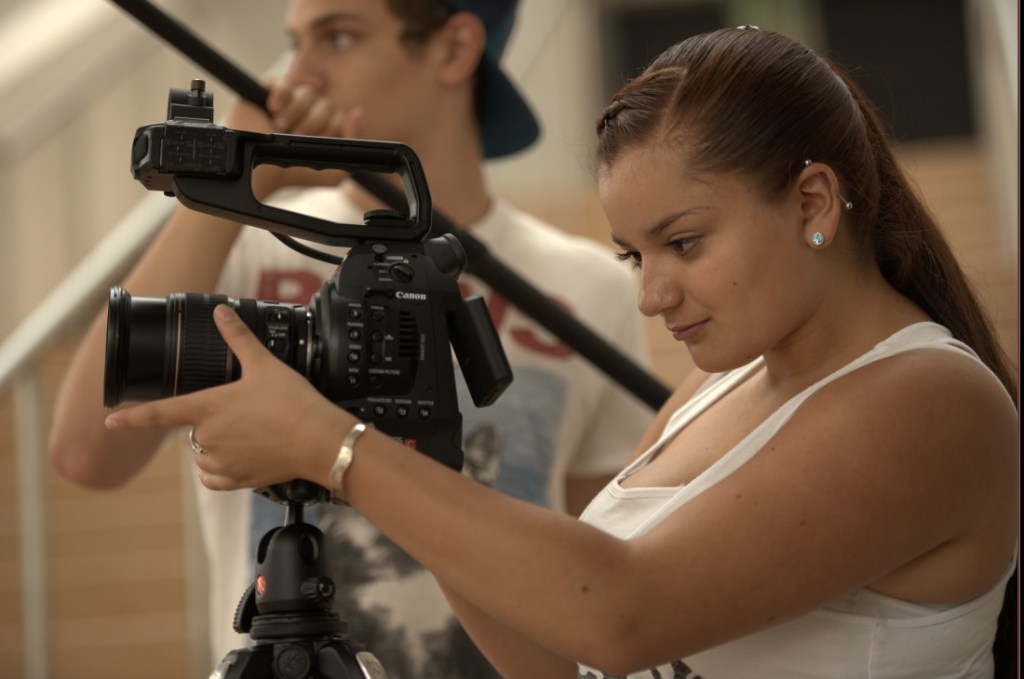
Featured Image: Students from the 2014 class at YDA are introduced to professional film equipment during the 7-week intensive program. Image provided by the Youth Documentary Academy. Used with permission.
 Bella Recca
Leave a comment